During the engineering phase of an industrial or commercial commercial network installation, one fundamental structural choice must be locked in: Shielded vs Unshielded LAN cables. Selecting the wrong cable type can either lead to unnecessary budgetary expenditures or leave your network vulnerable to crippling external environmental interference.
Decoding the Industry Acronyms
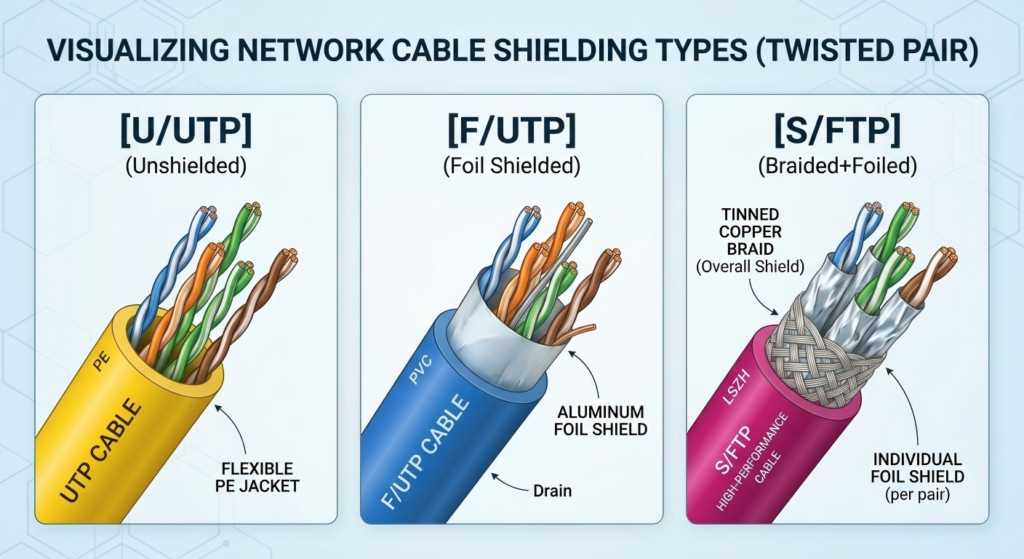
The international standard ISO/IEC 11801 utilizes a clear prefix notation (X/YUTP) to describe cable shielding architectures, where X denotes the overall external shield type, and Y defines the shielding for individual twisted pairs:
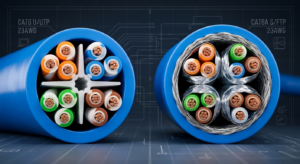
U/UTP (Unshielded Twisted Pair): Contains no metallic shielding. It relies entirely on the precise twisting metrics of the copper pairs and internal splines to cancel out noise. It is highly flexible, easy to terminate, and ideal for standard office spaces.
F/UTP (Foiled Twisted Pair): Features an overall aluminum foil wrap (Al-Mylar) surrounding all four internal pairs, complete with a solid tinned copper drain wire for grounding. This setup provides robust protection against moderate electromagnetic interference (EMI).
S/FTP (Shielded Foiled Twisted Pair): The gold standard of network isolation. Each individual internal pair is wrapped in its own protective aluminum foil sleeve to eliminate internal crosstalk, while an outer overall tinned copper braided wire mesh grid delivers maximum mechanical protection and absolute EMI block capability.
When Must You Go Shielded?
Unshielded cables are more than adequate for typical commercial office buildings where cross-talk and ambient EMI are minimal. However, shielded cables become mandatory in several key environments:
Industrial Automation Hubs: Factory floors with heavy electric motors, welding equipment, and high-voltage power lines running parallel to data conduits.
Broadcast and Data Centers: Co-located high-density server racks where hundreds of high-frequency data lines run tightly alongside each other, generating significant alien crosstalk.
Outdoor and Telecom Tower Runs: Shielded systems like Cat5e or Cat6 F/UTP with heavy black UV-resistant PE outer jackets protect critical signals from environmental radio frequency interference (RFI).
By mapping out the ambient electromagnetic profile of your project zone, procurement managers can strike the perfect balance between material cost and absolute system reliability.