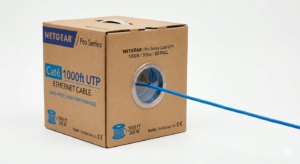
When deploying a structured cabling system for high-density enterprise environments, choosing the right infrastructure is a long-term investment. The decision often comes down to a critical comparison: Cat6 vs Cat6A. Understanding the technical differences in bandwidth, crosstalk management, and transmission speeds is essential for global procurement managers and network engineers looking to future-proof their operations.
Bandwidth and Transmission Speed
Standard Cat6 cables are designed to deliver a bandwidth of 250MHz and reliably support data rates up to 1000Mbps (1Gbps) over a 90-meter horizontal channel. While Cat6 can support 10Gbps at shorter distances under ideal conditions, it is inherently limited. In contrast, Cat6A (Category 6 Augmented) doubles the performance metrics, operating at a frequency of 500MHz and fully guaranteeing a 10Gbps LAN cable transmission speed across the entire 90-meter deployment channel.
Crosstalk Isolation: The Center Cross Design
As frequency increases, so does electromagnetic interference (EMI) and alien crosstalk (AXT) between adjacent cables. To combat this, high-quality Cat6 and Cat6A cables utilize an internal PE spline—a center cross framework that physically separates the four twisted pairs. In Owire Cat6A designs, this insulation is further optimized (often utilizing Foamed-PE with an expanded diameter of 1.35±0.1mm to maintain strict geometric symmetry and eliminate signal degradation over long distances.
Shielding Configurations for Enterprise Stability
For environments with high electromagnetic noise—such as factory floors, server rooms, or medical facilities—shielding becomes mandatory. While Cat6 is frequently deployed as unshielded (U/UTP), Cat6A infrastructure frequently utilizes sophisticated shielding architectures like F/UTP (foil shielded) or S/FTP (individual pairs foiled with an overall tinned copper braid). This comprehensive 360-degree shielding ensures pristine data integrity and maximum margin metrics when tested against rigorous industry standards.
For large-scale commercial buildings, data centers, and campus networks, investing in bulk Cat6A network cables eliminates the need for disruptive, costly recabling infrastructure projects over the next decade.